Middleton Mixology SmokeTop vs. Clones: Professional Review
Discover why professional bartenders choose the Middleton Mixology SmokeTop over cheap clones. Learn why durability and speed matter for high-volume bars.
The High-Volume Problem: Why Most Cocktail Smokers Fail the 'Friday Night Rush'
It's Friday night at 9 PM. Sixteen orders are lined up. A table of eight has just requested smoked old fashioneds. This situation is where true bar tools distinguish themselves from mere novelties, and it's exactly why reviews of the Middleton Mixology SmokeTop from professional bartenders consistently conclude that most cocktail smokers are not designed for high-volume settings.
The primary issue is speed. In a busy bar, a smoker must integrate seamlessly into the workflow without causing delays. Devices requiring extensive setup, prolonged torch use, or substantial cleanup become liabilities when the bar is bustling. What might seem sophisticated in a home setting during a leisurely weekend experiment can turn into a significant hurdle during peak hours.
Another challenge is maintaining flavor consistency. Smoke quality suffers from temperature fluctuations, wood char buildup, and operator fatigue. A bartender needs to deliver consistent results on the 40th cocktail, not just the first.
The best bar tools earn their keep by blending into the service flow. A smoker that demands constant attention is one that detracts from revenue.
The SmokeTop Solution: Engineering Speed and Flavor Purity
While most alternatives falter under the pressure of a busy Friday night, the SmokeTop® was specifically designed for such scenarios. Created by Seattle bartender James Middleton, this tool arose from genuine professional frustration experienced when service slowed due to inefficient smoking processes.
Its design reflects its origins. The SmokeTop's patented twin-tail airflow design (U.S. Patent No. 11,871,769) enables bartenders to complete the smoke infusion in about five seconds and move on to the next order. This speed is a carefully considered performance feature, tailored for real-world service conditions.
Equally important is flavor purity. Lower-quality tools often suffer from combustion bleed, producing harsh, uneven smoke that overpowers rather than complements the spirit. The SmokeTop's chamber design, underside grooves, and woven stainless steel screen are engineered to deliver clean, consistent smoke that enhances a bourbon's natural oak flavors rather than masking them.
For bar managers seeking the best cocktail smoker for high-volume bars, the distinction is clear: speed without flavor control is ineffective. The SmokeTop provides both, which is why more than 500 professional establishments have adopted it into their service programs.
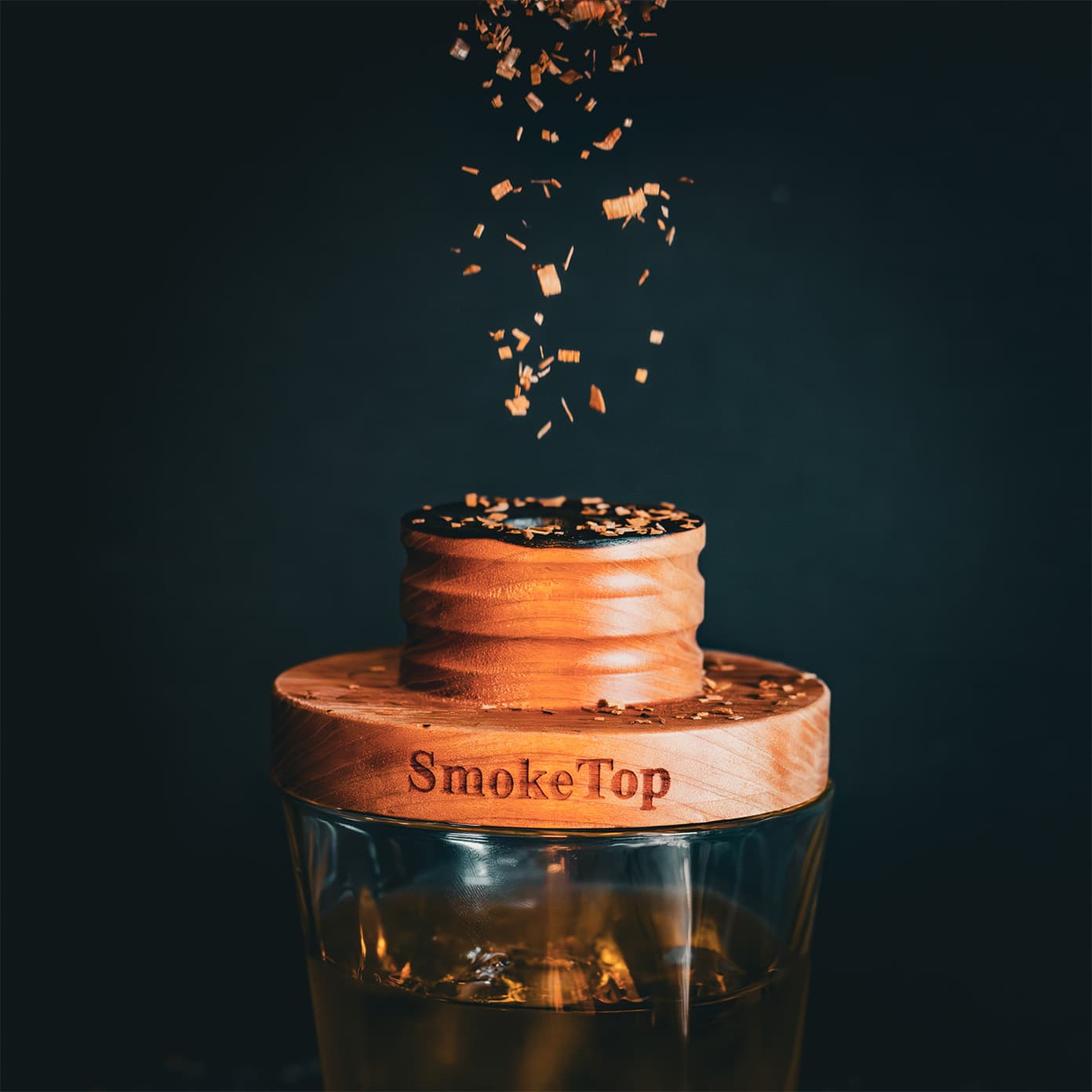
How the SmokeTop Compares: Smoke Gun vs Cocktail Smoker, and Everything Else
When comparing the SmokeTop with competitors, two main categories often arise: expensive electric smoking guns targeting the professional market, and unlicensed replicas of the patented SmokeTop design sold at low prices. For bar managers seeking a reliable smoking gun alternative or a commercial cocktail smoker, the table below illustrates where each category stands on essential service criteria.
|
Criterion |
SmokeTop® |
Electric Smoking Guns |
Knockoff Products |
|---|---|---|---|
|
Price tier |
Mid-premium |
$250 to $300+ |
$25 to $50 |
|
Patent protection |
U.S. Patent No. 11,871,769 (twin-tail airflow) |
None comparable |
None; imitates the patented SmokeTop form factor |
|
Operation |
Sits on the glass. Torch, ignite, done. |
Hose, motor, chamber, and battery. Multi-step setup and ventilation required. |
Form factor mimics the SmokeTop; build quality varies |
|
Speed under service |
~5 second infusion |
Typically 20+ seconds of exposure per drink to avoid bitterness, plus setup |
Varies |
|
Durability in heavy use |
500+ uses per unit |
Motors, fans, batteries, and cloche seals are documented failure points |
Widely reported issues with torch reliability and cracked chambers |
|
Built by a working bartender |
Yes, James Middleton (Seattle) |
No |
No |
|
Cost per use |
Under $0.20 in wood chips |
Wood chips plus battery and motor maintenance |
Wood chips plus part replacement risk |
|
Hands-free tableside |
Yes, sits directly on the glass |
No; operator holds the hose over each drink |
Depends on construction |
|
Power source required |
None (torch only) |
Battery or electric |
Torch only |
|
Documented commercial adoption |
500+ hospitality establishments |
Present in some kitchens and bars; known service-wear issues |
Primarily online retail; limited adoption in serious bar programs |
Electric smoking guns target professionals, but their high cost, complex setup, and wear issues make them unsuitable for high-volume bars. Unlicensed imitations mimic the SmokeTop's form at a lower price but lack the engineering and quality to withstand 500+ service cycles.
Why Smoking Guns Struggle on a Bar Rail
Professional bartenders comparing smoke guns to cocktail smokers often encounter the same issues with gun-style tools:
-
Exposure time accumulates. Most smoking guns need about twenty seconds of smoke exposure per drink for a clean infusion. Insufficient smoke results in a weak flavor, while too much leads to bitterness. This timing becomes problematic during a busy Friday night.
-
Cloche sealing is unreliable. Many professional smoking guns use glass cloches to contain smoke, but sealing at the base is often poor, causing smoke to escape during infusion.
-
Motors and fans wear out. Residue buildup reduces airflow, introducing unwanted flavors. Reports of motors failing within a year are common in this category.
-
Indoor ventilation is an issue. Operating a smoking gun behind a crowded bar fills the workspace with smoke, slowing service or requiring additional ventilation.
These aren't rare issues; they're why the best cocktail smoker for high-volume bars eliminates motors, hoses, and cloche dependencies entirely.
This operational reliability raises a key question: what does consistent, professional-grade smoke infusion mean for a bar's financial health?
The ROI of the Smoked Old Fashioned: A Bar Manager's Perspective
The case for the SmokeTop® extends beyond operations into clear financial territory. When evaluating SmokeTop vs competitors, the numbers tell a story that resonates with any bar manager watching labor costs and revenue per seat.
The math is straightforward:
-
Upsell potential: $3 to $5 premium per smoked cocktail above a standard pour
-
Cost per use: Under $0.20 in wood chips per drink
-
Net margin per cocktail: Routinely exceeds $4.00 on a single upsell
At moderate Friday volume, say 40 smoked old fashioneds across a shift, that represents roughly $160 to $200 in incremental revenue above standard menu pricing. Scale that across a full week and the SmokeTop® investment tends to pay for itself within days rather than months.
Beyond raw margins, there's a quieter revenue driver worth noting: tableside theater. A smoked cocktail prepared at the bar rail or guest table generates social media content that patrons share on their own. One well-timed pour under a cloche can reach thousands of impressions at zero marketing cost.
"A great product to elevate the taste, aroma, and presentation for classic Old Fashioneds or Boulevardiers."
— Samuel Stephens, Head Bartender, Henley (Nashville), via Chilled Magazine
A balanced view: these returns assume consistent execution. Staff training and wood chip inventory management are real operational requirements. Neither is complicated or expensive, but both are worth factoring into any ROI projection.
What makes this performance sustainable is precisely the speed and reliability explored in the previous section. How that translates to specific service contexts, including tableside presentation, private events, and mobile bars, shapes how operators get the most out of the tool.

Strategic Use Cases: From Tableside Service to Mobile Mixology
The financial case for the SmokeTop® stands on its own. Where a commercial grade cocktail smoker truly earns its place, though, is in the range of service environments it can handle without missing a beat.
High-volume bar programs are the obvious starting point. A busy craft cocktail bar running 80 to 120 covers on a Saturday night needs tools that perform consistently, not dramatically. In practice, the SmokeTop's compact footprint and rapid smoke delivery let bartenders produce a smoked Old Fashioned tableside or behind the bar with equal confidence. No cart required, no cumbersome apparatus to manage mid-rush.
Tableside is where the format genuinely comes into its own. Chilled Magazine's profile of SmokeTop inventor James Middleton highlights how the visual element, smoke billowing under a lowball glass, creates a shareable moment that guests document and post without any prompting. That organic reach has real marketing value.
Beyond the fixed bar, catering operations and mobile bartending setups benefit from the SmokeTop's portability. It requires no power source and no pressurized gas, only wood chips and a torch.
One honest caveat: tableside service does require brief guest education. Most bartenders, however, find that moment of explanation actually deepens engagement rather than slowing service.
Knowing where the SmokeTop fits is one piece of the picture. Getting the most out of it from day one takes a slightly different conversation.
Getting Started: Pro Tips for Workflow Integration
Translating strong cocktail smoker ROI for restaurants into actual dollars depends on one thing: how cleanly the tool fits into an existing workflow. Even well-designed equipment loses value if it creates friction behind the bar during a Friday rush.
Wood chip selection is the first decision point. Cherry and applewood pair naturally with bourbon-forward builds, while hickory suits mezcal and tequila applications. A common pattern in high-volume venues is to pre-portion chips by shift, removing the step entirely during peak service hours.
Another practical approach is to designate a dedicated smoke station, a small, well-ventilated section of the bar where glassware can be positioned consistently. That removes improvisation from the equation and allows staff to replicate the presentation precisely across every order.
A few integration benchmarks that experienced operators report:
-
Train staff on the five-step process before opening a single shift, not during service
-
Run at least 10 practice executions to build muscle memory on ignition and smoke timing
-
Position the station so guests have a clear sightline. The visual is part of the product.
The Middleton Mixology setup walkthrough offers a reliable starting reference for teams onboarding the tool for the first time.
Workflow integration matters, and so does the hardware holding up under daily commercial pressure. That brings us to the performance metrics that determine whether the SmokeTop® earns its place long-term.
Professional Performance Metrics: Durability, Airflow, and Maintenance
Any SmokeTop durability review has to start with the number that matters most in a commercial setting: 500+ uses per unit. In a high-volume bar environment, tools fail, and they tend to fail fast. When bar managers search for commercial cocktail smoker reliability, two patterns come up repeatedly in the category: motor and battery failures in electric smoking guns, and cracked chambers or dead torches in the unlicensed imitations sold on Amazon. The SmokeTop® is built to sidestep both failure modes, crafted from solid American cherry wood and stainless steel that withstand the repetitive thermal stress of nightly service without warping, clogging, or losing airflow consistency.
Airflow is where the design gap between the original and the unlicensed imitations becomes most visible in practice. The patented twin-tail airflow design, U.S. Patent No. 11,871,769, controls smoke direction and density with precision that look-alike knockoffs can't replicate, even when they copy the external form factor. What typically happens with lower-quality smokers is uneven burn, excess ash bypass, and inconsistent smoke volume, all of which translate directly into inconsistent guest experiences.
The takeaway on performance: a tool this reliable, this low-maintenance, and this consistent across hundreds of service cycles sets a professional standard. Whether that standard justifies the investment over alternatives is exactly the question the final verdict addresses.
Final Verdict: Is the SmokeTop Worth the Professional Premium?
When evaluating professional cocktail smoking equipment, the question isn't whether the SmokeTop® performs. The evidence across durability, workflow integration, and revenue impact is consistent. The real question is whether the premium is justified against cheaper alternatives. It is.
The case rests on three measurable pillars:
-
Financial return: A $3 to $5 upsell per smoked cocktail, across even modest volume, recovers the investment within weeks rather than months.
-
Operational reliability: 500+ uses per unit and a sub-$0.20 cost per cocktail keep margins predictable.
-
Professional credibility: Trusted by 500+ hospitality establishments and used in co-branded activations across Diageo portfolio brands including Bulleit, Crown Royal, Don Julio, Casamigos, and Johnnie Walker.

Where the SmokeTop Shows Up in the Industry
The SmokeTop is in active service at national hospitality groups like Rosen Hotels & Resorts, Hotel Kansas City, Hotel Indigo, BarLouie, and Landry's restaurants (including Portland City Grill). It also appears in co-branded engraved editions for distilleries and spirits programs including Bulleit, Buffalo Trace, Crown Royal, Don Julio, Casamigos, Johnnie Walker, Bardstown Bourbon, Angels Envy, Ardbeg, Bushmills, Basil Hayden, and Restless Spirits.
The original design is protected by U.S. Patent No. 11,871,769, a detail worth noting when comparing against look-alike products that lack the engineering refinements developed since 2018.
The SmokeTop® isn't the right fit for every operation. Lower-volume bars with no premium cocktail program may not generate enough throughput to justify the investment quickly. With that caveat aside, for bars focused on guest experience and revenue per cover, the decision tends to be a clear one.
As inventor James Middleton has outlined, the SmokeTop® was built by a working bartender for working bartenders, and that design philosophy shows in every detail. Choose accordingly.
Key Takeaways
-
Upsell potential: $3 to $5 premium per smoked cocktail above a standard pour
-
Cost per use: Under $0.20 in wood chips per drink
-
Net margin per cocktail: Routinely exceeds $4.00 on a single upsell
-
500+ uses per unit and 500+ hospitality establishments in active service
-
Train staff on the five-step process before opening a single shift, not during service
-
Run at least 10 practice executions to build muscle memory on ignition and smoke timing